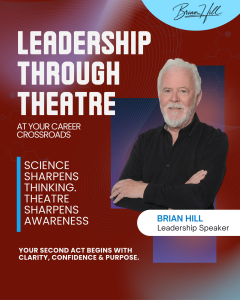
A certain moment arrives quietly. The work still looks successful, and the title still carries weight, yet something feels off. This moment often appears at a career crossroads at 50, not as a breakdown or failure, but as a pause between acts. Leadership Through Theatre offers a way to understand this moment with clarity, logic, plus human insight. It brings together two disciplines that rarely meet. Science. Theatre. One sharpens thinking. The other sharpens awareness. Together, they support a second-act career transition built on intention, not impulse.
Why Career Crossroads at 50 Feels Different
Earlier career transitions often focus on growth. Skills. Progress. Recognition.
Midlife transitions feel different.
Experience runs deep. Expectations run high.
Walking away feels risky. Standing still feels draining.
Many senior professionals feel stuck between roles that no longer fit and futures that feel unclear. This tension often shows up as quiet frustration. Or fading motivation. Sometimes burnout.
This is where career reinvention after burnout often begins. Not with change, but with reflection.
Leadership Through Theatre as a Different Lens
Most leadership models borrow language from sport or battle. Win. Compete. Execute.
Leadership Through Theatre takes another path.
Theatre trains attention.
Listening. Timing. Presence.
Responding, not forcing.
On stage, no one succeeds alone. The ensemble matters. Awareness matters. Curiosity matters. These skills transfer directly into leadership, especially during periods of uncertainty.
This approach supports staying curious in your career, even after decades of experience. Curiosity keeps leadership flexible. It keeps thinking open. It prevents expertise from turning into habit.
The Consultant Mindset for Career Growth
A scientist works with evidence. A consultant works with perspective.
Both step back before acting.
Applying a consultant mindset for career growth means learning to observe patterns, not just problems. It means asking better questions. It means separating facts from assumptions.
This same mindset can be applied beyond organisations.
It can be applied to life.
Applying a consultant mindset to life helps senior professionals evaluate options with clarity. What to keep. What to redesign. What to release. Decisions become structured, not emotional.
Rebuilding Confidence When Experience Feels Heavy
Confidence does not always grow with seniority.
Sometimes it erodes.
Many leaders face imposter syndrome in leadership later in their careers. Not because of lack of skill, but because the rules change. New technologies. New expectations. New language.
Leadership Through Theatre supports rebuilding confidence at work by shifting focus from control to presence. From knowing everything to staying engaged. Confidence becomes quieter. More grounded. More sustainable.
A brief example. A senior leader once admitted that certainty felt easier early on. Now, curiosity felt safer.
From Corporate Identity to Independent Authority
A second act does not require starting over.
It often involves redefining authority.
Many senior professionals explore a portfolio career after corporate life. Others move into fractional leadership roles for senior professionals. Some choose consulting as a second act.
These paths reflect a broader shift toward experience-led careers and independent expert careers. Value comes from judgment, not hours. From insight, not hierarchy.
This transition supports post-corporate career independence while preserving credibility.
Leadership in the Wisdom Economy
The modern economy increasingly values experience over speed. Insight over noise. Judgment over automation.
These are often described as wisdom economy careers. Careers built on discernment, ethics, plus human understanding.
Leadership Through Theatre aligns naturally with this shift. It strengthens the human skills machines cannot replace. Listening. Sense-making. Emotional intelligence.
This is where future-proofing soft skills for leaders becomes essential. Especially in discussions around Emotional Intelligence versus Artificial Intelligence leadership. Human leadership still matters. Especially in uncertain times.
Adaptive Leadership for the Next Act
Change rarely follows a script.
Leadership Through Theatre prepares leaders to work without one.
This builds adaptive leadership in uncertain times. Leaders learn to respond, not react. To notice what is happening, then choose deliberately.
This approach supports legacy building in business. Not through scale alone, but through influence. Mentorship. Long-term impact.
Authority becomes quieter. More precise. More human.
A Clear Next Step; Where the Second Act Begins
A career crossroads at 50 is not a problem to fix.
It is a moment to design.
Leadership Through Theatre offers a structured, thoughtful way to approach a second act career transition. One grounded in logic. In awareness. In lived experience.
A simple starting point may help. Pause. Observe what no longer fits. Notice what still energises you. Then consider what kind of leadership feels meaningful now.
That reflection can open the door to a second act built on clarity, confidence, plus purpose.
If this perspective resonates, exploring Leadership Through Theatre further may be a useful next step.