
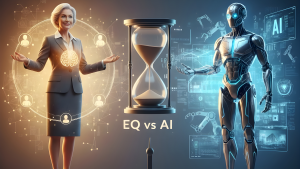
Artificial Intelligence is transforming the way work gets done. Analysis is faster. Decisions are automated. Outputs are instant. For many experienced professionals, this acceleration triggers a deeper question: If machines can think faster than humans, where does leadership truly fit?
The answer sits at the intersection of EQ vs AI — and it becomes especially powerful in your Second Act.
Why AI Is Advancing — and Leadership Is Being Redefined
AI thrives on logic, data, and repeatable patterns. It can optimise systems, predict trends, and increase efficiency. But leadership today is no longer about having the right answer first. It is about making sense of complexity, holding tension, and guiding people through uncertainty. These are not technical capabilities. They are human ones.
As organisations become more automated, leadership shifts from execution to interpretation — from control to clarity.
EQ vs AI: The Human Advantage Experience Creates
Emotional intelligence allows leaders to navigate nuance: sensing what is not being said, understanding emotional undercurrents, and responding with judgment rather than impulse. This is where experience matters. Leaders with decades of real-world exposure bring pattern recognition that no algorithm can replicate.
In the Wisdom Economy, value is no longer defined by speed alone. It is defined by discernment, perspective, and the ability to connect dots across people, systems, and situations. AI processes information. Human leaders transform it into meaning.
Leadership Through Presence, Not Power
Leadership today looks less like command-and-control and more like ensemble work. Much like theatre, effective leadership depends on presence, listening, timing, and adaptability. This idea of Leadership Through Theatre highlights how leaders step into roles that require awareness of context, emotional cues, and shared purpose rather than authority alone.
Great leaders read the room, improvise when the script changes, and understand that performance is relational, not solo. This form of adaptive leadership cannot be automated. It requires empathy, emotional range, and the courage to respond rather than react.
Future-Proofing Soft Skills in Your Second Act

Future-proofing your career is not about resisting AI. It is about integrating technology while strengthening the skills that make leadership meaningful: emotional intelligence, judgment, and human connection. These are the capabilities that grow stronger with age, reflection, and lived experience.
Your Second Act is not about competing with machines. It is about leading where machines cannot — through empathy, wisdom, and purpose. In the long run, EQ is not a “soft skill.” It is the most durable leadership advantage we have.